


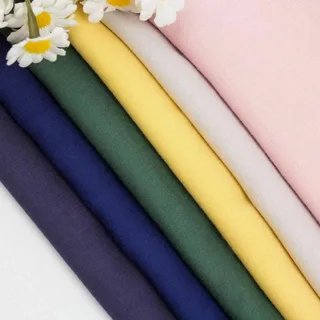
Starting a fashion label involves more than just great design. For many founders, the excitement hits a wall when they start sourcing fabric. You find the perfect material, only to learn the supplier demands a minimum order quantity (MOQ) that exceeds your entire annual budget.
This is the reality for countless European fashion startups. You need premium quality to compete in a crowded market, but buying thousands of meters upfront destroys your cash flow.
Fortunately, the supply chain is shifting. Manufacturers and platforms now understand the need for agility. This guide breaks down how to secure premium viscose fabric with low MOQs, helping you launch collections without overstocking.
What makes viscose a top choice?
Viscose is a semi-synthetic fiber derived from wood pulp. It acts as a bridge between natural fibers like cotton and synthetics like polyester. For fashion brands, it offers a specific set of advantages that make it highly desirable.
Key properties:
- Drape and feel: Viscose mimics the texture of silk. It hangs well on the body, making it ideal for dresses, blouses, and lining.
- Breathability: Unlike pure synthetics, viscose allows air to pass through, keeping the wearer cool.
- Dye absorption: The fiber holds dye deeply, resulting in vibrant, consistent colors.
Sustainability factor:
Sustainability drives the European market. While standard viscose production uses chemicals, newer variations like EcoVero or Lyocell focus on closed-loop systems and responsibly sourced wood pulp. Using these certified versions allows your brand to make credible eco-friendly claims.
The sourcing roadblock for startups
Why is finding viscose with low MOQs so difficult? Textile mills operate on scale. Setting up machines for dyeing or printing takes time and money. To make a profit, factories prefer long production runs—often requiring 1,000 to 3,000 meters per color.
Common issues startups face:
- High Minimums: Most premium mills won’t look at orders under 500 meters.
- Limited Stock: “Stock service” (ready-to-ship fabric) often lacks the specific weight or premium finish you need.
- Reliability: Finding a supplier who treats small orders with the same priority as large accounts is rare.
- Verification: Ensuring the viscose is actually sustainable requires documentation that many smaller suppliers fail to provide.
Criteria for selecting your supplier
You cannot afford to pick a partner based on price alone. When evaluating potential fabric sources, use this checklist to ensure they fit your business model.
1. Flexibility in Quantity
This is your non-negotiable. Look for suppliers who explicitly state they handle small batches. Some offer tiered pricing: you pay a surcharge for cuts under 50 meters, but this is still cheaper than buying 500 meters you don’t need.
2. Quality Consistency
Premium viscose should not pill easily or shrink excessively. Ask for technical data sheets regarding shrinkage rates and colorfastness. Always order sample headers before committing to bulk.
3. Certifications
If you market your brand as sustainable, your supplier must back it up. Look for:
- FSC (Forest Stewardship Council): Proves the wood pulp comes from managed forests.
- OEKO-TEX Standard 100: Ensures the fabric is free from harmful chemicals.
- Lenzing Certification: Verifies branded fibers like Tencel™ or EcoVero™.
4. Logistics and Lead Times
European startups need speed. If a supplier in Asia offers a great price but takes three months to ship via sea freight, you miss your selling window. Calculate the “landed cost,” which includes shipping and import duties.
Top sources for low MOQ viscose
Finding the right partner saves you months of frustration. Here are reliable avenues for European startups.
Fabriclore Pvt Ltd
Fabriclore stands out as a premier solution for brands that need flexibility without sacrificing quality. As one of the best local and online stores, they bridge the gap between large-scale manufacturing and startup needs.
Why brands choose Fabriclore:
- Low MOQ Customization: They allow you to customize fabric design, dyeing, and printing at low MOQs. This is rare in the industry.
- Diverse Range: Their catalog includes standard viscose, sustainable Liva, Tencel, Ecovero, and Modal.
- Tech-Enabled: Their platform offers transparency on delivery and order status, solving the communication gap often found in textile sourcing.
- Trusted History: They currently support over 400 private labels globally.
European Wholesalers
Distributors in countries like Germany, France, and the Netherlands buy bulk from mills and sell smaller cuts to brands.
- Pros: Fast shipping within the EU, no import duties.
- Cons: Higher price per meter; you are limited to what they have in stock (no custom prints).
Turkish Mills
Turkey is a textile powerhouse close to Europe. Many Turkish suppliers offer lower MOQs than Chinese mills and faster trucking delivery to EU countries.
- Pros: Good balance of quality and speed.
- Cons: MOQs are often around 100-200 meters, which might still be high for very small capsules.
Tactics for negotiating better terms
Even with low MOQ suppliers, negotiation helps you maximize your budget. Suppliers want long-term relationships, not just one-off sales. Show them you are serious.
- Project Your Growth: Share your business plan. If a supplier sees you plan to launch four collections a year, they may lower the MOQ for your first order to help you start.
- Consolidate Orders: Instead of ordering 50 meters of four different fabrics, order 200 meters of one base fabric and print four different designs on it. Digital printing makes this possible.
- Ask for “Sampling” Pricing: If you need a very small amount (e.g., 20 meters) for a photoshoot, ask if they can process it as a “sampling order.” You will pay a premium, but you won’t be stuck with excess stock.
- Piggyback on Large Orders: Ask the supplier if they have other clients running the same base fabric. You might be able to add your small quantity to their production run.
Success stories in sourcing
Seeing how others navigate this landscape proves it is possible.
Case A: The Capsule Collection
A new womenswear brand in Stockholm wanted to launch a summer line using custom-printed viscose. European printers demanded 300 meters per print. The brand turned to Fabriclore, leveraging their low MOQ digital printing service. They produced four unique prints on high-quality Lenzing EcoVero™ with only 50 meters per design. The collection sold out, and the brand avoided holding dead stock.
Case B: The Sustainable Essential
A Berlin-based startup focused on basic shirts needed certified organic viscose. They struggled to verify supply chains in Asia. By switching to a supplier with clear traceability and verified certificates (like FSC and Oeko-Tex), they justified a higher retail price point to their customers. The transparency built trust, and the brand grew its order volume by 200% in year two.
Securing your supply chain
Sourcing premium viscose with low MOQs is the foundation of a healthy fashion startup. It allows you to test the market, manage cash flow, and maintain high quality.
Don’t settle for inferior fabric just because the minimums are low. Platforms like Fabriclore prove you can access professional-grade, sustainable textiles and custom manufacturing even at the start of your journey. Focus on partners that offer transparency, certification, and the flexibility your business needs to scale.
The future of fashion is not in mass production, but in agile, high-quality collections. Choose a supplier that supports that vision.
Fabriclore highlights four main types of viscose fabric weaves on this page: Plain Weave Viscose, Twill Weave Viscose, Satin Weave Viscose, and Jacquard Weave Viscose. Plain weave viscose is described as simple, sturdy, and versatile for everyday clothing and home textiles. Twill weave viscose features a diagonal rib for added durability, making it suitable for trousers, jackets, and other hard‑wearing garments. Satin weave viscose offers a glossy, smooth, high–thread count surface ideal for eveningwear and lingerie. Jacquard weave viscose incorporates intricate woven patterns, used for upscale garments, decorative pieces, and couture applications.
Fabriclore is a leading B2B fabric sourcing platform dedicated to empowering fashion designers, apparel manufacturers, and clothing brands worldwide. With 10+ years of experience in the textile industry, we have built a trusted network that connects creativity with high-quality fabrics, ensuring seamless and efficient sourcing for every scale of production.
Our extensive collection includes natural fibers like cotton fabric, linen fabric, and silk fabric; man-made fibers such as viscose and polyester; along with sustainable options like LENZING™, LIVA™, BEMBERG™ Cupro, and organic cotton.
We offer four key services tailored to meet every design and production need:
- Dyeable Fabric – Woven RFD & greige, sustainable, and knitted fabrics.
- Dyed Fabric – Mill dyed, yarn dyed, Schiffli, and denim fabrics.
- Made To Order – Digital printing, screen printing, block printing, and dyeing solutions.
- Ready Stock – Block, screen, Ikat, tweed, and jacquard fabrics.
Explore our diverse range of custom-printed, ready mill-dyed, and yarn-dyed fabrics to find the perfect match for your next collection.
For personalized assistance or inquiries, reach out to us at [email protected].
Experience seamless, authentic, and affordable fabric sourcing with Fabriclore — your trusted partner with over a decade of expertise in the global textile industry.
